
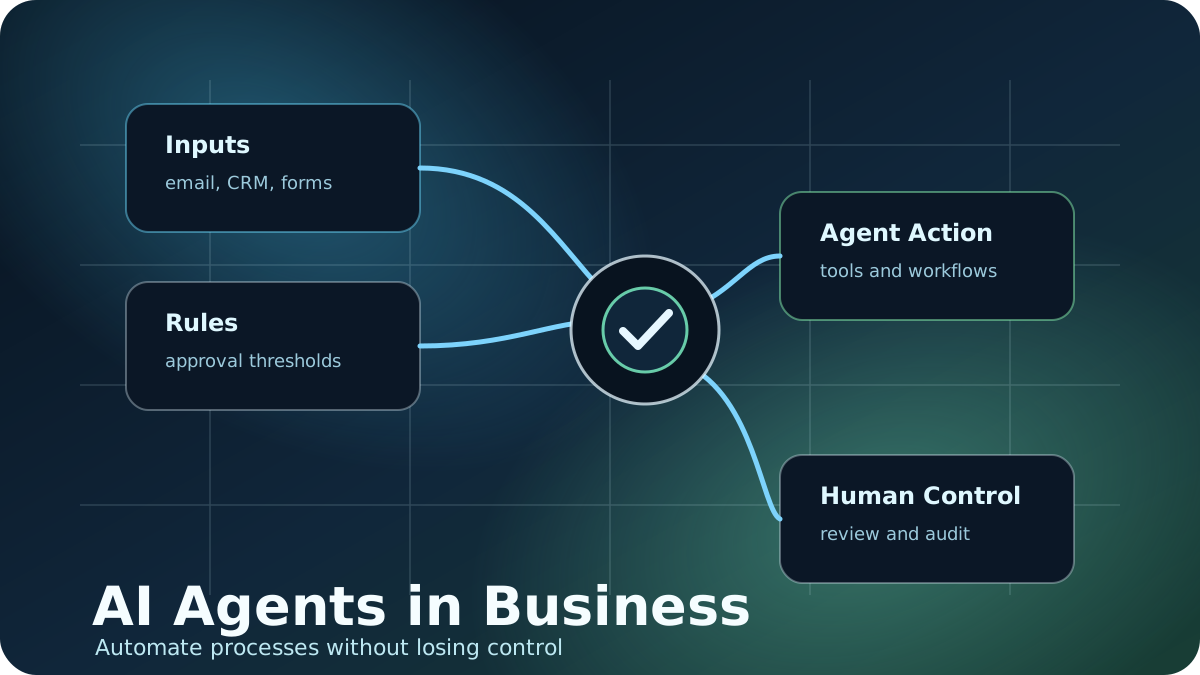
AI agents are moving from experiments to real business workflows. They can read context, choose tools, trigger actions, and coordinate multiple steps without waiting for a person at every click.
That power is useful, but it also creates a management question: how do you automate more work without turning critical decisions into a black box?
The answer is not to give agents unlimited autonomy. The answer is to design automation around clear goals, visible steps, human checkpoints, and measurable results.
What an AI Agent Actually Does
An AI agent is a system that can combine reasoning with action. Instead of only answering a question, it can execute a workflow:
- Understand a request or business event
- Collect information from internal tools
- Decide the next step based on rules and context
- Use APIs, databases, documents, or third-party services
- Produce a result that can be reviewed, approved, or applied automatically
In practice, an agent is most valuable when it handles the repetitive coordination work around a process: classification, routing, summarization, data entry, follow-ups, validation, or reporting.
Where Businesses Should Start
The best first use cases are not the most spectacular ones. They are processes with clear inputs, repeatable decisions, and visible outcomes.
Good candidates include:
- Customer support triage: classify messages, detect urgency, suggest responses, and route tickets
- Sales operations: qualify leads, enrich CRM records, prepare follow-up emails, and create tasks
- Finance and admin: extract invoice data, match documents, flag missing information, and prepare approvals
- HR workflows: screen incoming applications, summarize profiles, and schedule next steps
- Internal reporting: gather updates from tools, summarize progress, and highlight anomalies
Avoid starting with processes where the rules are unclear, data quality is poor, or the business impact of a mistake is high. Those can be automated later, after the organization has built trust in smaller flows.
Control Starts With Process Design
AI agents should not be dropped into an existing process as a magic layer. Before implementation, the workflow needs to be mapped in detail:
- What triggers the process?
- What data does the agent need?
- What decisions can be automated?
- Which actions require human approval?
- What should happen when confidence is low?
- How will the result be audited?
This structure turns agent automation into an operational system instead of an unpredictable assistant.
Use Human Approval Where It Matters
Not every step needs manual validation. If a support ticket is tagged incorrectly, the cost is usually small. If a contract is sent to the wrong customer, the cost can be serious.
The practical approach is to define approval levels:
| Risk level | Example | Recommended control |
|---|---|---|
| Low | Tagging a ticket | Fully automated |
| Medium | Drafting a customer reply | Human review before sending |
| High | Changing pricing or contract terms | Explicit approval and audit log |
This keeps automation fast where the risk is low, while protecting the decisions that affect customers, money, compliance, or reputation.
Make Every Agent Action Traceable
Control depends on visibility. A business should be able to answer four questions for every agent action:
- What input did the agent receive?
- What tools or data sources did it use?
- What decision did it make?
- What output or action did it create?
Traceability makes the system easier to debug, easier to improve, and easier to trust. It also helps teams identify whether a problem came from bad input data, weak instructions, tool failure, or a missing business rule.
Separate Business Rules From AI Reasoning
One common mistake is putting too much business logic inside prompts. Prompts are useful, but they should not become the only place where rules exist.
Critical rules should live in structured configuration, code, or workflow definitions. For example:
approval_rules:
  customer_email:
    send_automatically_when_confidence_above: 0.92
    require_review_when:
      - contains_discount
      - mentions_contract
      - sentiment_is_negative
  invoice_processing:
    require_review_when:
      - amount_above: 5000
      - missing_purchase_order: true
      - vendor_not_verified: true
The agent can still interpret context, but the business keeps ownership of the rules that matter.
Measure Automation Like a Business System
AI agent projects should be evaluated with operational metrics, not only with model accuracy.
Track metrics such as:
- Time saved per workflow
- Percentage of tasks completed without escalation
- Number of human corrections
- Error rate by category
- Customer response time
- Cost per completed process
- User satisfaction from internal teams
These numbers show whether the agent is actually improving the business, not just generating impressive outputs.
A Practical Implementation Roadmap
For most companies, a controlled rollout works better than a big launch.
- Pick one narrow workflow with repetitive work and measurable impact.
- Document the current process before adding automation.
- Define success metrics and risk levels.
- Build the agent with tool access limited to what it needs.
- Run in shadow mode so humans can compare the agent's recommendations with real decisions.
- Add partial automation for low-risk steps.
- Expand autonomy gradually only where data shows reliable performance.
This approach creates adoption without forcing teams to trust a system they cannot inspect.
Common Risks and How to Reduce Them
AI agents introduce new failure modes, but they can be managed with good architecture.
- Wrong decisions: use confidence thresholds, validation rules, and review queues
- Poor data access: connect agents only to trusted systems and define clear permissions
- Unexpected actions: require approval for external messages, payments, deletions, or contract changes
- Prompt drift: version prompts and workflows like software artifacts
- Lack of accountability: log every decision, tool call, and final action
The goal is not zero risk. The goal is managed risk with clear escalation paths.
How ContByte Approaches AI Agent Automation
At ContByte, we treat AI agents as part of a broader software system. The agent is only one component. Around it, we design integrations, permissions, validation, monitoring, dashboards, and human approval flows.
This makes automation useful in real business environments, where reliability matters as much as intelligence.
If your company wants to automate processes with AI agents, start with a workflow where the result can be measured clearly. From there, build control into the system from the first version.
Conclusion
AI agents can remove repetitive work, speed up decisions, and connect business tools into smarter workflows. But the companies that benefit most will not be the ones that automate everything blindly.
They will be the ones that automate deliberately: with clear rules, human checkpoints, traceable decisions, and continuous measurement.