
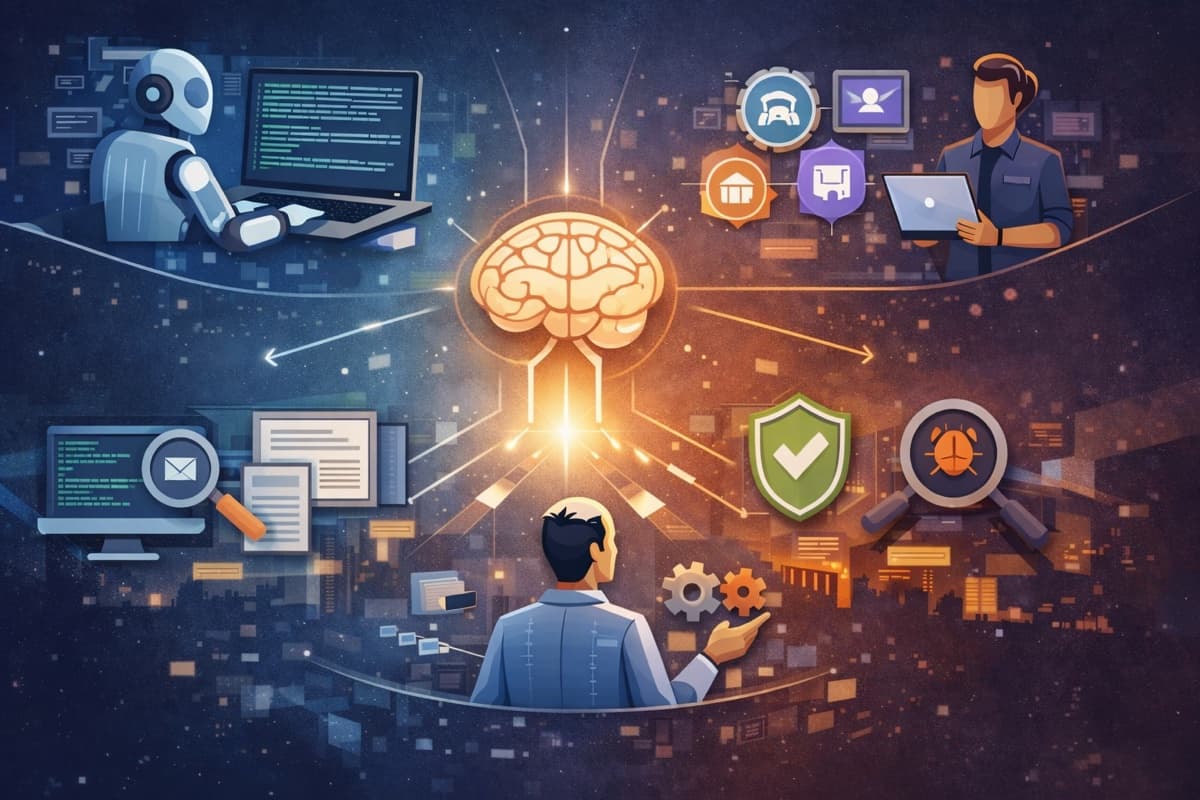
If you're a developer and you feel like the ground is shifting beneath your feet — you're right. The speed at which the software development ecosystem is evolving in 2026 is unprecedented. It's not just about new frameworks or languages, but a fundamental restructuring of how we write code, collaborate, and build careers.
Tools Have Become Teammates
For decades, the code editor was a passive tool: it wrote what you told it, offered trivial completions, and highlighted syntax errors. Today, a modern developer works with AI assistants that can:
- Understand the context of the entire project, not just the current file
- Propose architectures and justify technical decisions
- Write, test, and refine code at a complete feature level
- Detect security issues before they reach production
This shift doesn't mean programmers are being replaced — it means the entry and exit bars have moved. Juniors need to understand the generated code, not just copy it. Seniors need to know how to direct AI agents, not just compilers.
Role Fragmentation Is Deepening
A few years ago, "full-stack developer" was the aspirational title for most. Today, the ecosystem has exploded into new specializations:
Emerging Roles in 2026
AI Engineer — not an ML researcher, but a developer who integrates models, designs inference pipelines, and optimizes LLM interactions for real products.
Platform Engineer — the person who builds the internal tools that other developers use. GitOps, developer portals, self-service infrastructure.
DevEx Engineer — Developer Experience, a role dedicated to team productivity: tooling, documentation, onboarding, CI/CD velocity.
Security-first Developer — not a separate auditor, but a developer integrated into the team with direct responsibility for threat modeling and secure design.
Open Source Has Democratized Even Further
Open source AI models (Llama, Mistral, DeepSeek, and others) have radically changed access to advanced capabilities. Now, a small team can run a competitive model locally without paying per-token and without sending sensitive data to the cloud.
The consequence? The number of open source projects with AI capabilities has exploded. The npm, PyPI, and pkg.go.dev ecosystems are flooded with AI libraries — which makes critical knowledge of them even more important, not just blind consumption.
# A simple example: running a local model with Ollama
ollama run llama3.2

# Direct integration into your code
curl http://localhost:11434/api/generate -d '{
  "model": "llama3.2",
  "prompt": "Explain the difference between TCP and UDP in 2 sentences"
}'
Shipping Speed Has Increased, But So Has Complexity
Platforms like Vercel, Cloudflare Workers, Railway, and Fly.io have dramatically reduced the time from code to production. Deployment is no longer an event — it's a detail.
But this speed comes with a hidden cost: service sprawl. Small teams end up managing dozens of microservices, queues, distributed databases, and third-party integrations — infrastructure that previously required a dedicated ops team.
# A "modern minimal" stack for a medium-sized application
services:
  - Next.js on Vercel
  - Supabase (PostgreSQL + Auth + Storage)
  - Upstash Redis (rate limiting, caching)
  - Resend (transactional email)
  - Sentry (error tracking)
  - Posthog (analytics)
  - Cloudflare (DNS, WAF, CDN)
Each service has its own SDK, its own documentation, its own free tier, and its own billing model. System complexity has increased, even if the complexity of each individual component has decreased.
How You Learn in 2026 vs. 2016
The classic path — read a book, take a course, build a small project — hasn't disappeared, but it has compressed and fragmented.
Now:
- Official documentation is better than ever (many teams use AI to maintain it)
- Video tutorials have exploded, but so has variable quality
- LLMs can be interactive tutors — but they can also mislead with plausible but incorrect information
- Real projects remain the best way to understand the depth of a concept
The risk of the new paradigm: developers can advance quickly on the surface and remain fragile in depth. They know how to use an API, but don't understand what happens under the hood.
What Stays Constant
Through all these changes, some things never go out of style:
- Algorithmic thinking — AI can write code, but it can't think through the problem for you
- Debugging — understanding why something doesn't work remains an essential human skill
- Communication — with the team, the client, the documentation. Those who write clearly, think clearly
- Curiosity — the ecosystem changes fast; those who thrive are those who embrace change, not avoid it
The ContByte Perspective
At ContByte, we work at the intersection of these trends daily. We build products with small teams, adopt AI tools without neglecting fundamentals, and deliver solutions that last — not just ones that work today.
The ecosystem is changing. But this is also the most exciting time to be a developer.
Want to discuss how we navigate these changes in our projects? Contact us — we're curious about your challenges.